
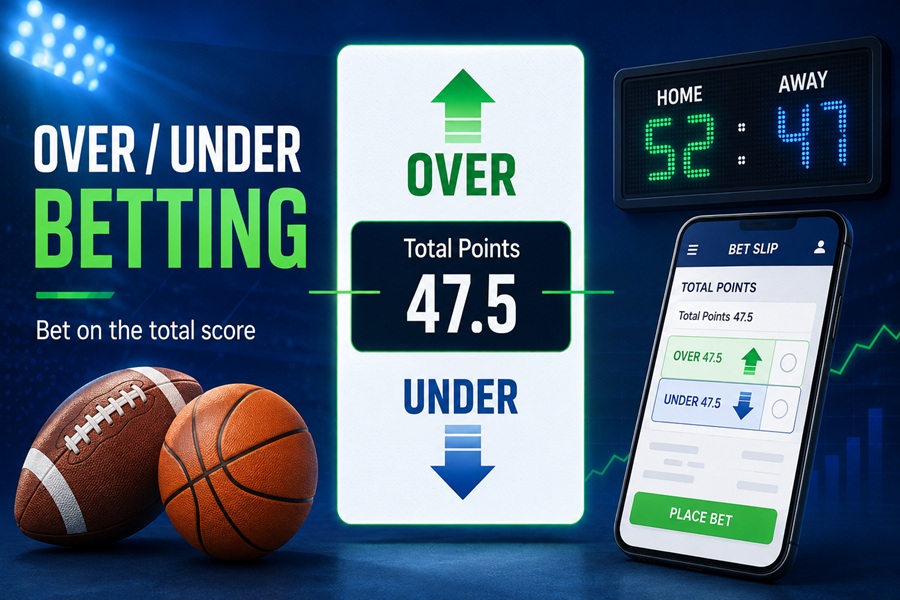
An over/under bet is a wager on the combined final score of both teams, not on who wins. The sportsbook posts a number called the “total.” You simply decide whether the real score will land over that number or under it.
That’s the whole concept. It’s one of the easiest bets to grasp, which is exactly why beginners love it. This guide breaks it all down, with real examples from football, basketball, and soccer.
The Core Idea in One Sentence
You’re not picking a winner. You’re predicting whether a game will be high-scoring (Over) or low-scoring (Under).
- Bet the Over = you think both teams combined will score more than the total.
- Bet the Under = you think they’ll score fewer than the total.
The over/under is also called the “total” or written as “O/U.” You’ll find it in almost every sport, right alongside the point spread and moneyline as one of the three main bet types.
How It Works: A Simple Example
Say the total for an NFL game is set at 47.5.
- Bet Over 47.5: you need 48 or more combined points to win.
- Bet Under 47.5: you need 47 or fewer combined points to win.
It doesn’t matter who wins the game. If the final is 30-20 (50 points), the Over cashes. If it’s 20-14 (34 points), the Under cashes. The winning team is irrelevant to the bet.
Why Totals Often Have a Half-Point
Notice that 47.5? That half-point (called “the hook”) is deliberate.
A half-point makes it impossible for the score to land exactly on the total. There’s no such thing as 47.5 combined points, so every bet is a clear win or loss. No ambiguity.
When a total is a whole number, like 47, something different can happen (more on that next).
What’s a “Push”?
If the total is a whole number and the combined score lands exactly on it, that’s a push.
- Example: total is 47, final combined score is exactly 47.
- Result: the bet is a tie. Your original stake is refunded, and nobody wins or loses.
This is why sportsbooks often use half-points, to avoid pushes entirely.
Reading the Odds: What -110 Means
Each side of an over/under comes with a price, known as the juice or vig. The most common is -110 on both sides.
Here’s what -110 means:
- You wager $110 to win $100 in profit.
- A winning $110 bet returns $210 total (your $110 stake back plus $100 profit).
Sometimes the two sides are priced differently to balance the action, like -115 on the Over and -105 on the Under. The number set by the book is the total; the odds next to it tell you the payout.
Quick payout example: at -110, a $100 bet on the Over returns about $190.91 total ($90.91 profit) if it wins.
Over/Under Examples Across Sports
The concept stays identical, but the numbers change dramatically by sport.
NFL (Football)
Totals usually sit in the 40s. A classic example: Super Bowl LIV between the Chiefs and 49ers had a total of 53. The final score was 31-20, or 51 combined points. That’s under 53, so Under bettors won.
NBA (Basketball)
Basketball is fast and high-scoring, so totals run into the 200s and 240s. Example: a Thunder vs Nuggets game with a total of 211.5.
- Over 211.5 at -115
- Under 211.5 at -105
If the game ends 120-115 (235 total), the Over easily wins.
Soccer
Low-scoring, so totals are small, often set at 2.5 goals.
- Over 2.5 goals: you need 3 or more total goals.
- Under 2.5 goals: you need 2 or fewer.
For a PSG vs Real Madrid match with a 3.5 total, four or more goals wins the Over; three or fewer wins the Under. It doesn’t matter which team scores them.
Baseball and Hockey
Totals are set in runs (baseball, often around 8 to 9) and goals (hockey, often around 5.5 to 6.5). Same logic: bet on whether the combined total clears the line.
Does Overtime Count?
Usually, yes. Overtime is treated as an extension of the game, and any points scored in OT count toward your over/under, unless the sportsbook specifically states otherwise.
Some markets have exceptions. An elimination soccer match might specify the total covers 90 minutes plus stoppage time only, excluding extra time and penalties. Always check the market rules before betting.
How Sportsbooks Set the Total
The total isn’t a random guess. Oddsmakers build it by analyzing:
- Offensive and defensive strength of both teams
- Pace of play (fast teams push totals up)
- Player injuries (a star scorer sitting out can drop the line)
- Weather (wind and rain lower scoring in outdoor sports)
- Recent form and head-to-head history
- Betting market trends and public money
Real-world shift: an NBA total might open at 228.5, but if a star scorer is scratched before tip-off, it could drop to 224.5. That’s why some bettors target the softer opening number before news breaks.
Live Over/Under Betting
You can also bet totals during the game, with lines updating in real time based on pace and scoring.
Example: an NBA game opens at 212.5, but a fast first quarter pushes the live total to 224.5. If you think scoring will cool off, you might take the Under 224.5 at the new live odds. Live totals add flexibility for bettors who read the flow of a game well.
Over/Under vs. Other Bet Types
| Bet Type | What You’re Predicting |
|---|---|
| Over/Under (Total) | Combined score, high or low |
| Point Spread | Margin of victory |
| Moneyline | Which team wins outright |
The over/under’s appeal is that you can enjoy a game’s flow without caring who wins. Root for offense (Over) or defense (Under).
Can You Combine Totals in a Parlay?
Yes. Totals can be included in parlays and same-game parlays, mixed with spreads, moneylines, and player props. Combining multiple bets raises the potential payout but requires every leg to win.
Many books also offer alternate totals, letting you move the line up or down for adjusted odds. Want a safer Under? Take a higher alternate number at a lower payout.
Frequently Asked Questions
What does over/under mean in betting?
It’s a bet on the combined final score of both teams. Bet the Over if you think scoring will be high, the Under if you think it’ll be low. The winner of the game doesn’t matter.
What happens if the score lands exactly on the total?
That’s a push. Your stake is refunded and no one wins. Half-point totals exist specifically to prevent this.
Does overtime count toward the over/under?
Usually yes, overtime counts as part of the game. Always check the specific market rules, since some have exceptions.
What does the half-point in a total mean?
The half-point makes it impossible to land exactly on the number, guaranteeing a clear win or loss with no push.
What does -110 mean on an over/under bet?
It’s the price. You wager $110 to win $100 in profit. A winning bet returns your stake plus the profit.
Is over/under betting good for beginners?
Yes. It’s one of the simplest bets because you only choose high or low scoring, with no need to predict the winner or the margin.
Can I bet over/under on individual players?
Yes. Many books offer totals on specific stats, like a player’s points, yards, or goals, not just the full-game score.
