
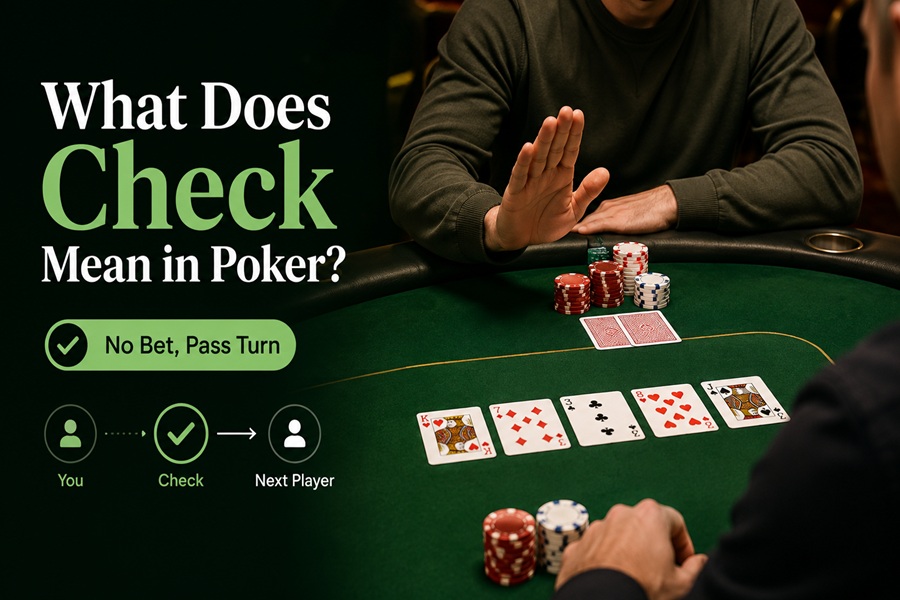
To check in poker means to pass your turn without betting, while keeping your cards in the hand. You put no chips in the pot and pass the action to the next player.
That’s the core idea. But knowing when you can check, when you can’t, and how to use it well is what separates beginners from sharp players. Here’s the complete breakdown.
The One-Sentence Definition
A check is declining to bet when it’s your turn, without folding. You stay in the hand, commit no chips, and hand the decision to the next player.
Think of it as saying “I’ll stay in, but I’m not betting right now.” The word “pass” is a common synonym.
The Golden Rule: You Can Only Check If No One Has Bet
This is the single most important thing to understand about checking.
You can only check when the current bet is zero. In other words, nobody before you in the round has bet.
- If no one has bet yet, your options are check or bet.
- If someone has already bet, checking is off the table. Now you must call, raise, or fold.
Once a bet is out, you can’t check past it. You have to at least match it (call), increase it (raise), or give up (fold).
The Four Basic Poker Actions
Checking is one of four moves you can make when the action reaches you. Here’s how it fits with the others:
| Action | What It Means | When It’s Available |
|---|---|---|
| Check | Pass without betting | Only if no one has bet |
| Bet | Put chips in first | Only if no one has bet |
| Call | Match the current bet | Only if someone has bet |
| Raise | Increase the current bet | Only if someone has bet |
| Fold | Give up the hand | Any time |
Notice the pattern: check and bet are a pair (used when the pot has no active bet), while call and raise are a pair (used when there’s a bet to respond to).
How to Check at the Table
Checking is simple to signal:
- Tap the table with your fingers or knuckles, or
- Verbally announce “check.”
Both are binding. Once you check, you’re held to it. If you say “check” and then try to say “bet $100,” the bet won’t be accepted. You’ve already acted.
Why You Can’t Check Preflop (In Most Games)
Here’s a point that confuses new players. In games with blinds like Texas Hold’em, you usually can’t check on the first betting round (preflop).
Why? The blinds are forced bets posted before the cards are dealt. That means there’s already an active bet on the table when action begins, so checking isn’t allowed.
The one exception: if you’re the big blind and everyone just calls (no one raises), the action comes back to you with no raise to face. Since your blind already covers the current bet, you can check to see the flop for free. This is often called the “big blind option.”
When Should You Check? (Strategy)
Checking isn’t just a passive default. Skilled players use it deliberately. Here are the main reasons to check:
1. To see a free card. If you’re on a draw (say, a straight draw) and you’re the last to act, checking lets you see the next card without risking chips.
2. To control the pot size. Checking keeps the pot small when you have a marginal hand you don’t want to bloat.
3. To induce a bluff. By checking a strong hand, you look weak. This can tempt an opponent to bet with a worse hand, letting you win more.
4. To balance your range. Good players check some strong hands and some weak ones. This keeps opponents guessing about what a check really means.
5. To set up a check-raise (more on this below).
The Check-Raise: Poker’s Classic Trap
The check-raise is one of the most powerful deceptive plays in poker, and it starts with a check.
How it works:
- You check, appearing weak or uninterested.
- An opponent takes the bait and bets.
- You then raise in the same round.
The goal is to win more money than you would by betting straight out. You check hoping someone bets, then spring the trap. In older poker circles, this move was sometimes called “sandbagging.”
A note: some casinos and certain game variants (like some forms of lowball) historically restricted the check-raise, so house rules can vary. In most modern games, it’s standard and allowed.
When NOT to Check (Common Mistakes)
Checking isn’t always the right move. A few costly errors to avoid:
- Checking top pair in position. If you flop a strong pair and check, you lose value and give opponents a free card that could beat you. Usually you should bet for value instead.
- Checking a strong hand on a dangerous board. Letting opponents see free cards can let them catch up and outdraw you.
- Over-checking out of fear. Passive players who always check give away that they’re weak, letting opponents run them over.
The lesson: check with a purpose, not out of hesitation.
Check vs. Fold vs. Call: Don’t Mix Them Up
Beginners sometimes confuse these. Quick clarification:
- Check = stay in, bet nothing (only when no bet is out).
- Fold = give up your cards and leave the hand.
- Call = match a bet someone else made.
Checking keeps you in for free. Folding removes you from the hand. Calling costs you chips to stay in against a bet.
Frequently Asked Questions
What does it mean to check in poker? It means passing your turn without betting while keeping your cards. You commit no chips and pass the action to the next player.
Can you check preflop in poker? Usually not, because the blinds count as an active bet. The exception is the big blind, who can check if no one raises.
Can you check if someone has already bet? No. Once there’s an active bet, you must call, raise, or fold. Checking is only possible when the bet is zero.
How do you signal a check? Tap the table with your fingers or say “check” out loud. Both are binding actions.
What is a check-raise? It’s when you check first, wait for an opponent to bet, then raise in the same round. It’s a deceptive play used to win larger pots.
Is checking the same as passing? Yes. “Pass” is a common synonym for check in poker.
Does checking cost any money? No. Checking puts zero chips in the pot. It’s a free way to stay in the hand.
