
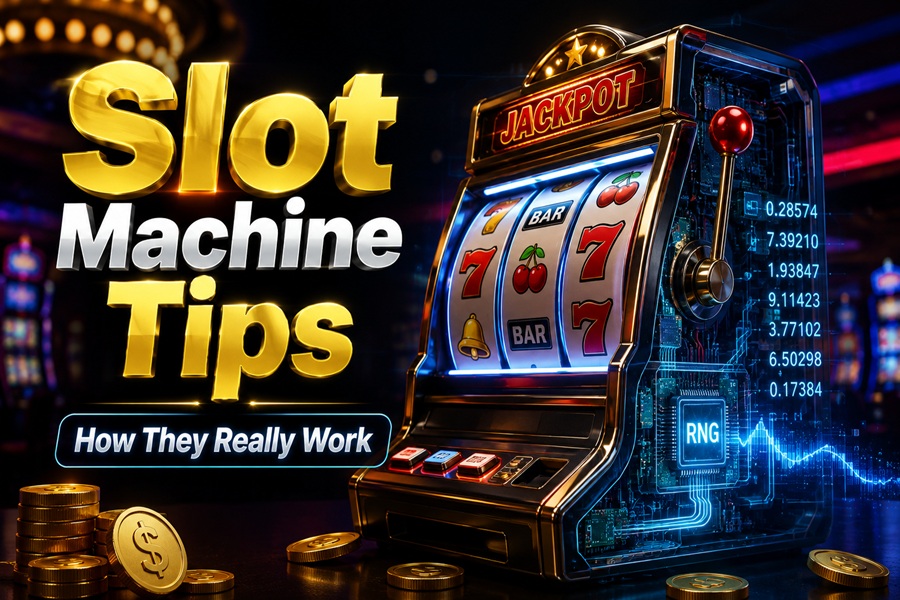
Most slot “tips” fail because they’re built on a wrong idea of how the machine thinks. So before any tip, here’s the truth: a slot machine decides your outcome the instant you hit spin, using a number generator that doesn’t remember, doesn’t warm up, and doesn’t care how long you’ve been sitting there.
Understand that, and the useful tips fall into place while the useless superstitions fall away. This guide is built around the myths, because busting them is the real lesson.
Myth 1: “The reels decide the outcome as they spin”
Reality: The outcome is locked in before the reels even move.
At the heart of every slot, online or on a casino floor, is a Random Number Generator (RNG). It’s an algorithm that spits out numbers constantly, thousands per second, even when nobody is playing.
The moment you press spin, the RNG grabs a number from that stream. That number is your result. The spinning reels are just a fancy animation playing out a decision that was already made in a fraction of a second.
So “stopping the reels at the right moment” does nothing. The show is for you. The math already happened.
Myth 2: “A machine that hasn’t paid in a while is ‘due'”
Reality: Slots have no memory. Nothing is ever “due.”
This is the single most expensive myth in the building. Every spin is a completely independent event. The RNG does not track history.
- A machine that hasn’t hit in hours is not more likely to hit.
- A machine that just paid a jackpot is not less likely to pay again.
The probabilities reset on every single spin. Thinking a cold machine “owes” you is exactly the trap that keeps players feeding it. There’s no cycle to exploit because there’s no cycle at all.
Myth 3: “Hot and cold machines are a real thing”
Reality: Hot and cold streaks are pattern-seeking in pure randomness.
Humans are wired to see patterns. Line up enough random spins and your brain invents streaks, lucky machines, and unlucky corners of the casino. None of it is in the code.
If someone just won big on a machine, that machine isn’t “tapped out.” If it’s been dead all night, it isn’t “ready.” Both are stories we tell ourselves about noise.
Myth 4: “The casino flips a switch to make me lose”
Reality: Casinos can’t change a single spin in real time, but the long-term math is already stacked.
Here’s the nuance. A casino cannot watch you and tweak an individual outcome on the fly. Once a machine is set, it runs on its fixed mathematical model.
What the casino does control is the RTP (Return to Player), a long-term setting baked into the game. That’s not cheating on any one spin. It’s just the built-in house edge doing its slow, guaranteed work across millions of spins.
And on fairness: reputable licensed casinos submit their RNGs to third-party audits by regulators. The randomness is verified. The house doesn’t need to rig anything, because the edge is already in the design.
The Two Numbers That Actually Matter
Forget lucky charms. If you want to understand a slot, learn these two figures.
RTP (Return to Player)
RTP is the average a slot pays back over the long run.
- A 96% RTP slot returns about $96 for every $100 wagered across millions of spins. The house keeps the other $4.
- 96% is roughly the average for online video slots.
- Crucial catch: RTP is a long-term statistic. In the short term, anything can happen. You can lose fast on a high-RTP slot or win big on a low-RTP one. RTP describes the ocean, not your single wave.
Volatility (Variance)
Volatility describes the shape of the ride, how the wins arrive.
| Volatility | What to Expect | Suits |
|---|---|---|
| Low | Frequent small wins | Longer, steadier sessions, smaller bankrolls |
| High | Rare wins, but bigger when they land | Jackpot chasers with a bankroll to survive dry spells |
RTP tells you the long-run cost. Volatility tells you how bumpy the road feels getting there. Neither changes your odds on a given spin, but together they define your experience.
Online vs. Land-Based: Same Engine, Different Dashboard
Both use identical RNG math. The practical differences are what matter to your wallet:
- RTP tends to be higher online. Lower overhead lets online casinos run RTPs that almost universally clear 94%. Physical machines in airports, bars, or low-regulation spots can legally run far lower, sometimes down in the 70s.
- Online publishes the numbers. Licensed online casinos usually list each game’s RTP and volatility. On a physical floor, that info is rarely posted, so you’re playing blind on the math that matters most.
- Online plays faster. More spins per minute means your bankroll can drain much quicker if you’re not watching.
So What Are the Real Tips?
Given all of the above, honest tips can only do one thing: manage your risk and stretch your entertainment. They cannot change the odds. Within that honest frame:
- Pick higher-RTP games when you can see the number. It nudges long-term value in your favor.
- Match volatility to your bankroll. Small budget, low volatility. Big budget and patience, high volatility.
- Set a budget before you start and treat it as the price of entertainment, not an investment.
- Take breaks. Slots are engineered to create a “flow state” where time vanishes. A timer breaks the trance.
- Never chase losses. The machine doesn’t know you’re down, and it won’t feel sorry for you.
The Honest Bottom Line
Slots are mathematically designed to take in more than they pay out. That’s not a conspiracy, it’s the business model. The RNG makes each spin genuinely random, RTP sets the long-run cost, and volatility sets the mood.
Everything else, hot machines, cold machines, lucky timing, “due” payouts, is your brain finding shapes in static. The best “tip” isn’t a trick to win. It’s knowing the rules well enough to play for fun, on purpose, within a budget you set in advance.
