
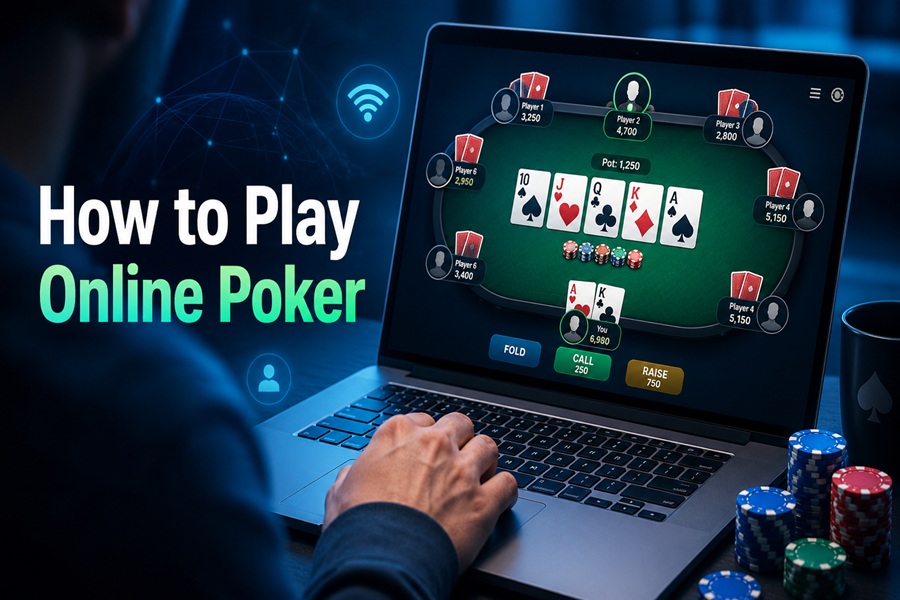
Online poker lets you play real card games from your phone or computer, against other people rather than the house. If you can learn the hand rankings and a few basic rules, you can sit down at a table today.
This guide walks you through everything from zero: the hand rankings to memorize, how to pick a site, playing your first hand, and the handful of strategy fundamentals that separate winning beginners from players who lose for months. We’ll focus on Texas Hold’em, the most popular variant by far and the one you’ll find everywhere.
First, Understand What Online Poker Actually Is
Online poker is a card game played through a licensed operator’s software. The key thing to grasp:
You are not playing against the casino. You’re playing against other humans. The operator hosts the game, matches you with opponents, and takes a small fee called rake from each pot. The rest of the money moves between players.
One more thing to expect: online poker plays about three to four times faster than live poker. There’s no physical chip handling or shuffling, so hands fly by. That speed is great for learning but can overwhelm beginners, so start slow.
Step 1: Memorize the Hand Rankings
Before anything else, you must know which hands beat which. This is non-negotiable. Here they are, from strongest to weakest:
| Rank | Hand | Example |
|---|---|---|
| 1 | Royal Flush | A-K-Q-J-10, same suit |
| 2 | Straight Flush | Five in a row, same suit |
| 3 | Four of a Kind | Four cards of same value |
| 4 | Full House | Three of a kind + a pair |
| 5 | Flush | Five cards, same suit |
| 6 | Straight | Five in a row, any suits |
| 7 | Three of a Kind | Three cards of same value |
| 8 | Two Pair | Two separate pairs |
| 9 | One Pair | Two cards of same value |
| 10 | High Card | No made hand |
A couple of fun facts to anchor these: you’ll make one pair about a third of the time on the flop, while a Royal Flush shows up on average only once every 30,940 hands. Don’t hold your breath for that one.
The goal in Texas Hold’em is to make the best five-card hand using any combination of your two private cards and the five shared community cards.
Step 2: Learn How a Hand Is Structured
Texas Hold’em runs in four betting rounds. Each player gets two private cards (called hole cards), and five community cards are revealed in stages.
| Stage | What Happens |
|---|---|
| Preflop | You get 2 hole cards; first betting round |
| The Flop | 3 community cards dealt; second betting round |
| The Turn | 1 more community card; third betting round |
| The River | Final community card; last betting round |
| Showdown | Remaining players reveal hands; best hand wins |
On each round, you choose from four actions: check (pass without betting), bet/raise (put chips in), call (match a bet), or fold (give up the hand). The small blind and big blind are forced bets that start the action preflop.
Step 3: Choose a Site (And Understand the Legal Picture)
This is where online poker gets specific to where you live. In the US, online poker is regulated state by state, not federally.
The current US landscape (subject to change):
- Real-money online poker is legal and live in a small group of states, commonly including Nevada, New Jersey, Delaware, Pennsylvania, Michigan, and more recently West Virginia.
- A few more states (such as Connecticut, Rhode Island, and Maine) have passed laws but may not yet have active sites.
- Some regulated states share player pools through the Multi-State Internet Gaming Agreement (MSIGA), which means bigger tournaments and fuller tables.
Regulated US operators you may encounter include BetMGM Poker, WSOP Online, PokerStars (on FanDuel), Borgata Poker, BetRivers Poker, and DraftKings Poker, depending on your state.
Important cautions:
- Stick to sites licensed in your state. Offshore sites operate in a legal gray area and sit outside US consumer-protection law, so your funds aren’t protected the same way.
- Don’t use a VPN to sneak onto sites not available where you are. Operators detect this and can seize your funds.
- Legal details change often. Always verify the current rules for your location before depositing.
If real-money poker isn’t available where you are, many social or sweepstakes casinos offer poker with virtual chips or Sweeps Coins as a legal alternative in more states. Check their terms.
Step 4: Start With Free or Micro-Stakes Games
Do not jump straight into high-stakes real-money tables. Instead:
- Use play-money tables first. Nearly every site offers free games to practice with zero risk. This is the best way to get comfortable with the software and pace.
- Then try micro-stakes. Look for tables labeled “micro stakes” or “beginner.” You can often start with just a few dollars.
- Choose the right format. A cash game lets you sit and leave anytime. A “sit-and-go” is a small single-table tournament that’s great for beginners.
Step 5: Play Your First Hand (Walkthrough)
Here’s what actually happens when you sit down:
- Take a seat at a low-stakes cash game or sit-and-go.
- When it’s your turn to post the blinds, your chips go in automatically.
- Two hole cards appear on your screen.
- Decide whether to play. For your first sessions, play tight: only continue with strong hands.
- Act on each betting round using check, bet, call, raise, or fold as the community cards are revealed.
- Reach showdown or win when everyone else folds.
What “playing tight” means for beginners: only continue with genuinely strong starting hands, such as high pairs (tens or better), A-K, A-Q, or suited connectors like J-10 of the same suit. Fold everything else. This one habit prevents most beginner losses.
Step 6: Learn the Core Strategy Fundamentals
A few basics will put you ahead of most casual players:
Position is power. Where you sit relative to the dealer button matters enormously. Acting after your opponents gives you information about what they did, letting you make better decisions. Play more hands in “late position” and fewer in “early position.”
Play tight-aggressive. Enter fewer hands, but bet and raise confidently with the strong ones you do play. Passive calling bleeds chips; controlled aggression wins them.
Understand pot odds. Compare your chance of completing a winning hand (your equity) to the price of calling. If your odds of winning are worse than the pot odds you’re getting, folding is usually correct.
Bluff sparingly at first. As a beginner, focus on playing solid hands. Bluff only in spots where the board and your betting story make it believable. Expand bluffing later as you gain reads.
Manage your bankroll. Set a budget you can afford to lose and stick to it. Never chase losses. A common rule is to only sit down with a small fraction of your total poker funds at any one table.
Step 7: Follow Basic Online Etiquette
Good habits keep you welcome and out of trouble:
- Don’t slow the game down. Act in reasonable time.
- No trash talk in the chat.
- Never use multiple accounts. That’s cheating and gets you banned.
- Play only with money you can afford to lose.
Common Beginner Mistakes to Avoid
- Playing too many hands. The number one leak. Fold more.
- Ignoring position. Playing weak hands out of position costs money.
- Chasing losses. Trying to win back losses fast leads to bigger losses.
- Jumping stakes too fast. Move up only when you’re consistently winning at your current level.
- Skipping the free tables. Practice first; it’s free education.
Frequently Asked Questions
How do I start playing online poker as a beginner?
Memorize the hand rankings, pick a licensed site or a free-play option, start at play-money or micro-stakes tables, and play tight with only strong starting hands.
Is online poker legal in the US?
It’s legal in a handful of regulated states and unavailable in most others. Legality depends entirely on where you’re located, so always check your state’s current rules.
Do I need real money to learn online poker?
No. Nearly every site offers free play-money tables, and social or sweepstakes casinos let you play with virtual currency. Practice there first.
What’s the best poker game for beginners?
Texas Hold’em. It’s the most popular variant, found on virtually every site, and the foundation for learning other games.
How is online poker different from live poker?
It plays much faster, around three to four times the speed, and uses software instead of physical chips. The rules of the game itself are the same.
How much money do I need to start?
Very little. Micro-stakes games can start with just a few dollars, and free tables cost nothing. Only ever play with money you can afford to lose.
What does the operator get out of it?
The site takes a small fee called rake from each pot. That’s its entire business model, since players compete against each other, not the house.
